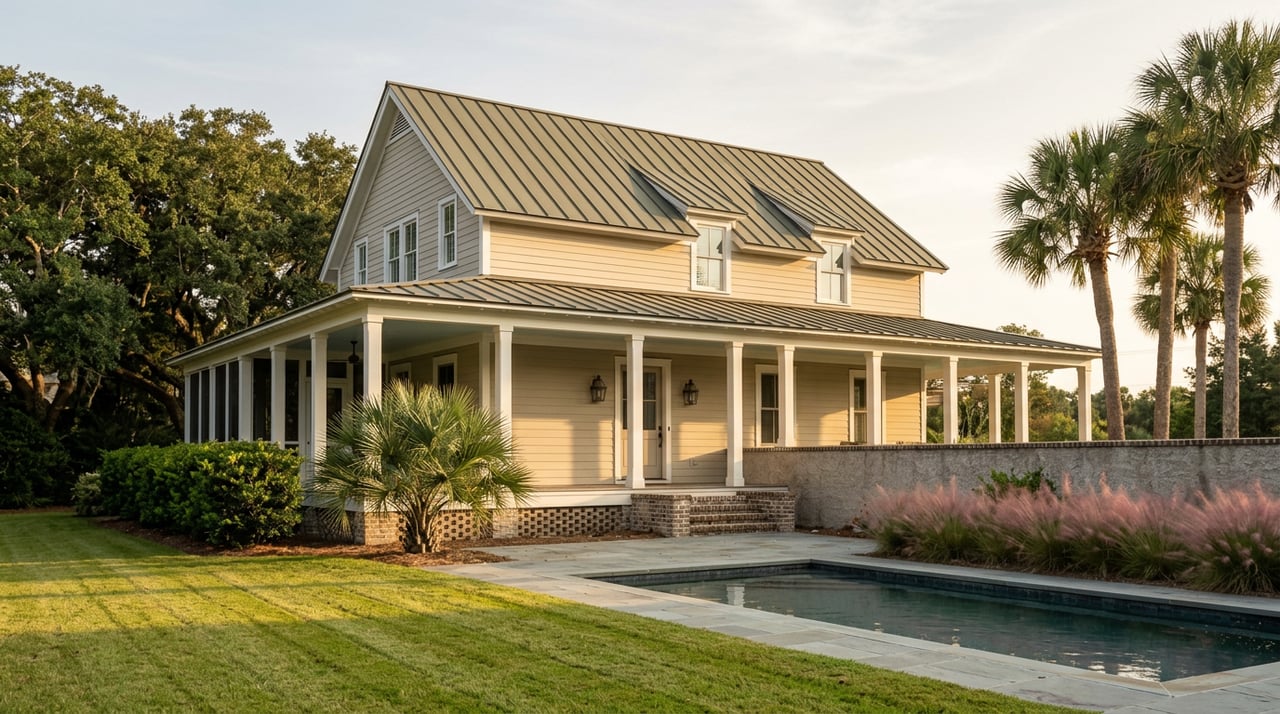
If you've been comparing Bluffton to other Lowcountry towns this year, you've probably run across the same reassuring line: prices have leveled off. The steep climbs of a few years back have slowed to something closer to normal. On paper, that's true. What the headline number leaves out is what's actually changed underneath it, and it isn't the price. It's how long a home now sits before someone buys it.
That distinction matters if you're deciding between Bluffton and Beaufort, or Bluffton and a corner of Hilton Head, because the price you'll pay and the process you'll go through to get there are turning out to be two very different stories this year.
The Number Everyone Quotes
Bluffton's median sale price has been climbing steadily since 2021, when it sat around $375,000. It moved to roughly $470,000 in 2022, $514,000 in 2023, and $540,000 in 2024. In 2025 it dipped slightly to around $526,000, a rare pause after four straight years of gains. By early spring 2026, one closely watched local tracker had the year-to-date median back at a new high near $550,000.
Redfin's read on the broader Bluffton market for the three months ending July 2026 shows a median sale price of $560,000, up 3.2% from the same period a year earlier. Price per square foot actually slipped 2.0% over that same window, landing around $251. Put those two together and you get a market that's appreciating, but only modestly, and unevenly depending on the size and type of home changing hands.
None of that reads like a market under stress. It reads like a market catching its breath. Which is exactly why the next number is the one worth paying attention to.
The Number That Actually Moved
Days on market in the combined Hilton Head Island and Bluffton multiple listing service has climbed sharply through 2026, and not by a little.
| Month (2026) | Median Sale Price | YoY Price Change | Days on Market | YoY DOM Change | Sale-to-List Ratio |
|---|---|---|---|---|---|
| February | $485,000 | -19.1% | 134 | +116.1% | 96.8% |
| March | $599,990 | +9.0% | 138 | +91.7% | 96.9% |
| April | $580,800 | +4.6% | 131 | +89.9% | 97.4% |
| May | $572,000 | +2.0% | 125 | +95.3% | 97.4% |
Look at what's constant across four consecutive months. Price swings between roughly flat and modestly up. Days on market is up somewhere between 90% and 116% year over year, every single month. And the sale-to-list ratio, which measures how close the final sale price lands to the original asking price, barely moves at all, holding in the high 96% to low 97% range throughout.
That last figure is the key to reading this correctly. Sellers are not slashing prices to move houses faster. They're still getting almost exactly what they asked for. What's changed is how long they're willing to wait for a buyer to show up and agree to that number. Redfin's Bluffton-specific figures tell the same smaller-scale story: homes there are averaging 63 days on market as of July 2026, up from 59 a year earlier.
For a buyer, this is the part of the market that actually works in your favor right now. The leverage isn't showing up as a discount off list price. It's showing up as time: room to schedule a real inspection, negotiate repairs without racing a backup offer, and walk through a home twice before writing an offer instead of once. For a seller, it means pricing accurately from day one matters more than it did two years ago, because the market is no longer forgiving an ambitious number with a quick sale anyway.
Two Zip Codes, One Bluffton Address
The citywide median is also quietly averaging two different markets together, and the gap between them is wide enough to change what a given budget actually buys.
As of early September 2026, homes currently listed in the 29910 zip code, which wraps around Buckwalter, New Riverside, and the Palmetto Bluff corridor, carry a median asking price near $652,500. A few miles away in 29909, home to Oldfield and other south-side addresses, that same list-price median runs closer to $549,900. That is a gap of more than $100,000 sitting inside a single town's mailing address.
Some of that gap is simple geography. Palmetto Bluff and the newer sections of Buckwalter and New Riverside skew toward larger homesites and newer construction, which pulls the 29910 asking-price median higher. But the size of the gap is still a useful warning: a citywide "Bluffton median" is really an average of two zip codes that don't behave like one market.
If you're comparing Bluffton to another town based on a single median number, you're really comparing an average of a $650,000 zip and a $550,000 zip. Which side of that average you land on depends entirely on which streets you're looking at, not on the town's name.
What This Changes If You're Weighing Bluffton Against Somewhere Else
A few practical adjustments follow from all of this, whether you're comparing neighborhoods within Bluffton or comparing Bluffton to Beaufort, Hilton Head, or Charleston.
- Ask for the days-on-market trend in the specific community you're considering, not just the town-wide figure. A 125-day average across the whole Hilton Head-Bluffton market can hide a home that would sell in three weeks in one neighborhood and three months in another.
- Budget for community fees separately from the purchase price. Bluffton has a large number of planned communities, and development-related fee schedules published by the Town of Bluffton show real variation between them, from Buckwalter to the Palmetto Bluff and New Riverside area to Village at Verdier Plantation. None of that shows up in a median sale price, but all of it shows up on a closing statement or a monthly HOA bill.
- Read the sale-to-list ratio as your negotiating temperature gauge, not the headline price change. A market sitting at 97% of list with rising days on market is telling you buyers have room to negotiate on terms and timeline, even when the price itself barely moves.
- Separate list price from sold price when you're zip-code shopping. The $652,500 figure for 29910 reflects what sellers are asking today, not what buyers are ultimately paying, and the two numbers can move at different speeds.
None of this means Bluffton has cooled off in any way that should worry a buyer or seller. It means the market is expressing its current state through a different number than the one most people are watching. The median price is the story you already know. The days-on-market trend is the one that explains what's actually happening to a specific offer on a specific street.
A Few Questions Worth Asking Before You Compare Towns
If homes are taking longer to sell, does that mean prices are about to drop? Not necessarily. Every reading in this data shows sellers still capturing 96% to 97% of their asking price even as days on market climbed. A longer runway to sale is different from a falling price. It's a sign that buyers have more time to be selective, not that sellers are giving up ground on value.
Is the price gap between 29910 and 29909 just about location, or does it reflect different kinds of homes? Both. Part of the gap reflects genuine differences in lot size, water access, and amenities between communities like Palmetto Bluff and areas closer to Oldfield. Part of it also reflects the mix of what's currently for sale in each zip code at any given moment, which is why comparing a specific home against recent closings in its own micro-market tells you more than comparing zip-code averages.
If you're weighing Bluffton against another Lowcountry town, or trying to figure out which pocket of Bluffton actually fits your budget and your list, I'd rather walk you through the current data on the specific streets you're considering than hand you a citywide average and call it done. That's the kind of detail that changes an offer strategy, not just a search filter.
If you'd like to talk through what a specific Bluffton neighborhood looks like right now, Let's Connect and I'll pull the real numbers for the area you have in mind.