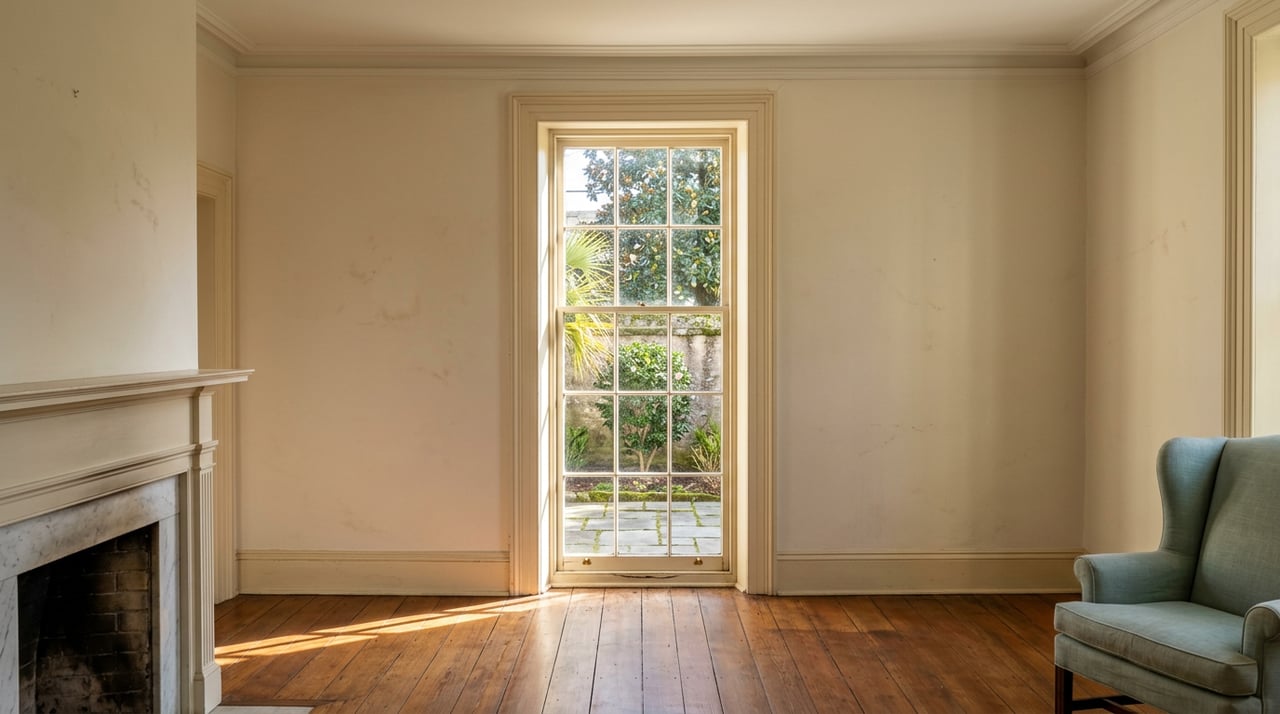
In 2005, the Baptist Church of Beaufort paid $230,000 for a house in the Old Commons neighborhood, built between 1875 and 1880 by Black artisans working in the years right after Emancipation. The church wanted to turn it into a ministry center. The city's Historic District Review Board looked at the renovation scope, decided the work needed to run as high as $400,000, and the building sat empty for seven years while the church tried to make the math work. When the congregation floated a plan to tear the house down and put in a prayer garden instead, the board said no. Beaufort's Redevelopment Commission eventually stepped in with a land swap, taking title to the house in exchange for two nearby properties, stabilizing the structure, and selling it to be renovated as a private residence.
That story gets told in Beaufort as a preservation success. For a buyer, it is also a warning label. A house in this district is not fully yours to change the moment you close. And the rule that trips people up is not the size of the review board or the strictness of its taste. It is a matter of sequence: whether you file the right paperwork before you swing a hammer, or after.
What "Contributing" Means, and Why It Isn't on the Listing Sheet
Beaufort's original 304-acre town grid, laid out in 1711, was listed on the National Register of Historic Places in 1969 and named a National Historic Landmark District in 1973. Inside that boundary, the city's five-member Historic District Review Board decides whether a home qualifies as a "contributing" structure, using the 1997 Beaufort County Above Ground Historic Sites Survey as its baseline. A contributing property adds to the district's historic character. A non-contributing one, usually newer or heavily altered, does not.
That single word determines whether replacing a window, adding a porch, or rebuilding a roof requires a Certificate of Appropriateness from the board before a permit gets pulled. It also determines whether the house is eligible for the tax incentive most buyers only hear about after they've already started work, which is too late.
None of this shows up in an MLS listing. Two homes on the same block, priced within $20,000 of each other, can carry completely different renovation rules depending on which side of that 1997 survey they fall on.
The district itself splits into five distinct neighborhoods, each with a different feel and a different price ceiling:
| Neighborhood | Character | What buyers tend to find |
|---|---|---|
| The Point (Old Point) | Riverfront, Victorian and Queen Anne homes under live oak canopy | The district's largest and most expensive homes |
| The Bluff | Bay Street and North Street corridor, includes the art deco U.S. District Courthouse | Some of the city's most recognizable historic homes |
| Downtown | Commercial spine along Bay Street | Mixed residential and commercial, close to Henry C. Chambers Waterfront Park |
| Old Commons | Northeastern grid, undergoing reinvestment | Medium-sized homes, often at a lower entry point than the Point or the Bluff |
| Northwest Quadrant | Historically Beaufort's African American neighborhood | Early 20th century homes, increasing renovation interest |
The Bailey Bill Only Works If You Apply Before You Start
South Carolina's Bailey Bill lets local governments freeze a historic property's assessed value at its pre-renovation level for a set number of years, so a homeowner who pours money into a restoration doesn't get hit with a higher tax bill the moment the county reassesses. Beaufort adopted its version in late September 2014. If a property owner invests at least 75 percent of the building's assessed value back into eligible rehabilitation work, and the board approves it, the assessed value gets frozen for the next 10 years.
The catch is procedural, not financial. The freeze is not something you apply for after the fact once the receipts are in. Beaufort's process runs in this order:
- Attend a pre-application conference with city staff
- Bring the proposal to a Historic Review Board meeting, which happens on the second Wednesday of each month at 2 p.m.
- Receive preliminary approval and sign a Memorandum of Understanding before work begins
- Complete the renovation, then file the Part B application for final approval
Application fees run $150 for a single family home or duplex, $300 for other building types, and the first Historic Review Board application fee is waived. Miss the board's monthly meeting and the next chance is a month away, which matters if a closing date and a contractor's start date are already set.
Buyers who fall for a fixer-upper in the Point or the Bluff often assume they can renovate first and sort out the tax paperwork later. By the time they ask, the county has already reassessed based on the finished work, and the 10-year freeze is off the table for good.
The House Survived Two Centuries. The Insurance Still Isn't Automatic
Roughly four in ten structures inside Beaufort's original town grid sit within a mapped Special Flood Hazard Area, according to a Sea Grant Law and Policy Journal analysis of the city's flood insurance rate maps. A standard homeowners policy does not cover flood damage, historic designation or not. Inside an SFHA, separate flood insurance is required to close most mortgages, and it is a real, recurring cost that belongs in the same conversation as the tax freeze math, not a footnote to it.
This is where the Bailey Bill and the flood insurance question start to talk to each other. A buyer weighing whether a renovation clears the 75 percent investment threshold for the tax freeze should be running that number against the actual carrying cost of the house, flood premium included, not just the purchase price.
What the Current Market Says About Timing
Over the three months ending in May 2026, Beaufort's median sale price held near $489,000, up modestly from the year before, while the median number of days a home sat on the market climbed to 78, up from 61 the previous year. County-wide, the median listing price reached $529,200 in July 2026, according to Realtor.com data tracked by the Federal Reserve Bank of St. Louis. Homes are not moving as fast as they were a year ago, and that slower pace is exactly the window in which a Bailey Bill timeline stops being a scramble and starts being a plan.
A slower market gives a buyer room to build the paperwork sequence into the offer itself: verify contributing status before writing the offer, structure the closing date around the board's monthly meeting schedule rather than against it, and get the Bailey Bill pre-application conversation started before the ink dries rather than after the first wall comes down.
Before You Write the Offer
Ask your agent to confirm whether the specific house is listed as a contributing structure under the 1997 survey, not just whether it sits inside the historic district boundary. Ask whether the property falls in an SFHA and get a flood insurance quote before the inspection period ends, not after. If a major renovation is part of the plan, build the pre-application conference into your timeline before closing, since the board's monthly cadence means a missed meeting is a missed month.
A Few Questions Buyers Ask Before Closing
Does the Bailey Bill apply to condos or only single family homes? The base structure of the program applies to any qualifying historic building, though the application fee is lower for single family homes and duplexes than for other building types.
Who decides if a house is "contributing"? The Historic District Review Board makes that determination using the 1997 Beaufort County Above Ground Historic Sites Survey as its primary reference.
Can I find out before I make an offer? Yes. The city's Historic District Review Board maintains records tied to individual properties, and a buyer's agent can request that status check as part of due diligence, well before an inspection contingency deadline.
Beaufort's historic district rewards buyers who understand its sequence and quietly costs the ones who don't. If you are weighing a house in the Point, the Bluff, or any of Beaufort's other historic neighborhoods and want someone who has already walked this paperwork with other buyers, Kim McElman can help you sort the timeline before you write the offer, not after. Let's Connect.